
Every major facility generates organic waste. Food plants and distribution centers move tons of material that can decompose safely when managed under controlled conditions. Industrial composting turns that same waste into verified results, lower emissions, documented landfill diversion, and nutrient recovery that feeds productive soil instead of filling a pit.
What Industrial Composting Means
Modern systems scale natural decomposition into a controlled industrial process.
Large-Scale Biological Conversion
This process refers to the large-scale biological conversion of organic material into a uniform, high-quality product. Unlike small backyard piles, it operates under regulated temperature and airflow systems where moisture and oxygen are continuously monitored.
These precise environmental controls maintain ideal conditions for microbial activity, accelerating decomposition and producing a finished product suitable for agricultural or landscape use.
Advanced Facility Capabilities
Modern composting operations are engineered for throughput, safety, and quality control at commercial volumes.
These engineered systems:
- Maintain internal temperatures above 131 °F to ensure pathogen reduction
- Balance aeration and moisture to optimize microbial activity
- Track operational data to confirm compliance and efficiency
This design enables facilities to handle continuous input streams efficiently and produce consistent, predictable outcomes, a critical advantage for food manufacturers, distribution centers, and municipalities that rely on maintaining steady volume and quality standards.
Feedstocks and Inputs
Because of that precision, can accept a wide variety of organic materials at scale, including:
- Food scraps and paper fiber
- Landscaping debris and yard waste
- Food residuals and compostable packaging
- Biosolids and manufacturing by-products
Each feedstock type requires a balanced carbon-to-nitrogen ratio to support ideal microbial activity. Proper mixing and aeration ensure every material type reaches complete biological stabilization without odor or pathogen risk.
Regulated Process and Performance Standards
The process follows EPA Process to Further Reduce Pathogens (PFRP) criteria—e.g., ≥ 131 °F for 3 days (in-vessel or aerated static pile) or 15 days with five turns (turned windrow)—followed by curing. This ensures the final compost is:
- Safe for agricultural and landscaping applications
- Free from pathogens and disease vectors
- Consistent in nutrient balance and texture
By managing decomposition under precise, repeatable conditions, industrial systems achieve measurable greenhouse-gas reductions and deliver stable, verifiable material quality compared with landfilling.
How Commercial-Scale Composting Works
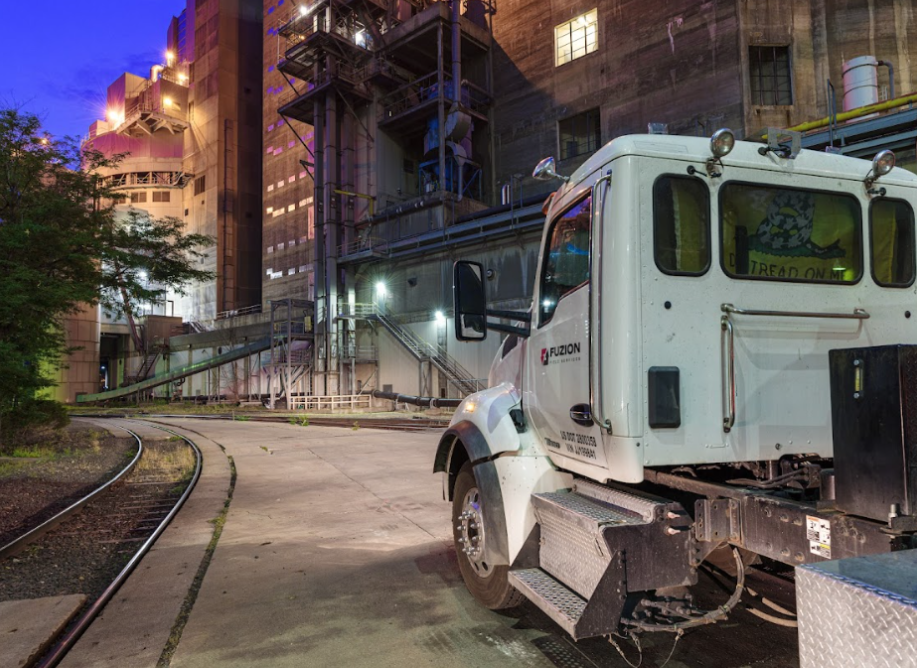
Large-scale industrial composting depends on organization in the field; collection, transport, and processing must run in sequence for the system to perform reliably.
Collection and Transport
On the ground, it starts with organized pickup routes and steady transport. Fuzion coordinates segregated collections that prevent contamination and move materials directly to regional composting facilities.
Each load is weighed, screened, and mixed to balance the carbon-to-nitrogen ratio—about 30:1 for optimal microbial activity. That balance determines whether the pile heats evenly and reaches regulatory temperature thresholds.
Active and Curing Phases
During the active phase, forced-air aeration or mechanical turning introduces oxygen while moisture stays near 50 percent. Temperatures rise to EPA-required levels to accelerate microbial breakdown and satisfy time–temperature criteria.
The curing phase allows stabilization before final screening removes oversized material for reuse as bulking agent. The result is a uniform, fully matured compost ready for agricultural or landscaping use.
Field Verification and Data Transparency
Every movement is traceable. Fuzion’s hauling documentation links generator sites to intake points and finished output, a complete chain that gives sustainability managers verified diversion data.
Operational reliability and reporting accuracy are maintained through:
- Route scheduling optimized for haul efficiency
- Container placement that limits cross-contamination
- Continuous monitoring of load quality and contamination rates
These controls allow clients to maintain consistent diversion performance and transparent sustainability reporting across multiple facilities.
Key Processing Methods at Industrial Scale
Large composting operations typically use one of three primary methods:
- Windrow composting — Organic material is piled in long rows turned every few days to maintain aeration; suitable for open sites and typically requires 60–90 days including curing.
- Aerated static-pile composting — Air is forced through perforated pipes at the base of a stationary pile; ideal for high-volume food waste with minimal turning, reaching pathogen-reduction temperatures for roughly 21 days.
- In-vessel composting — Materials are processed inside enclosed drums or tunnels where temperature, oxygen, and moisture are computer-controlled; shorter processing time (14–21 days) and reduced odor potential.
All three methods achieve the same outcome, a mature compost verified to meet local and federal health standards before agricultural use.
Environmental and Regulatory Benefits
At full scale, composting turns waste diversion into measurable environmental performance, reducing greenhouse gases, restoring soil nutrients, and supporting verified compliance.
Emission Reduction and Climate Impact
Composting organic waste at scale delivers quantifiable carbon benefits. Independent life-cycle assessments show substantial CO₂-equivalent reductions versus landfilling, often on the order of ~50–70% in modeled scenarios, primarily by avoiding methane from anaerobic decay.
These avoided emissions are among the strongest documented gains in circular-economy programs, especially for food and paper waste streams.
Finished Compost Quality and Certification
The finished compost retains key nutrients, about 1.5–2 % nitrogen, 0.8–1 % phosphorus, and 1–2 % potassium by weight, making it a valuable soil amendment.
Facilities producing agricultural-grade compost commonly pursue certification under:
- Biodegradable Products Institute (BPI) programs
- ASTM D6400 specifications for compostable materials
These frameworks confirm feedstock suitability, contamination limits, and decomposition performance under commercial operating conditions.
Compliance and Corporate Sustainability Alignment
Because large-scale composting follows EPA-approved treatment methods, facilities operate under strict controls for vector-attraction reduction, pathogen management, and runoff containment.
This oversight gives sustainability teams confidence that diversion data align with recognized environmental accounting standards. Many corporate and state programs now classify composting as a preferred landfill-diversion practice, supporting LEED certification objectives and broader ESG reporting metrics.
Fuzion’s Role in Industrial Composting
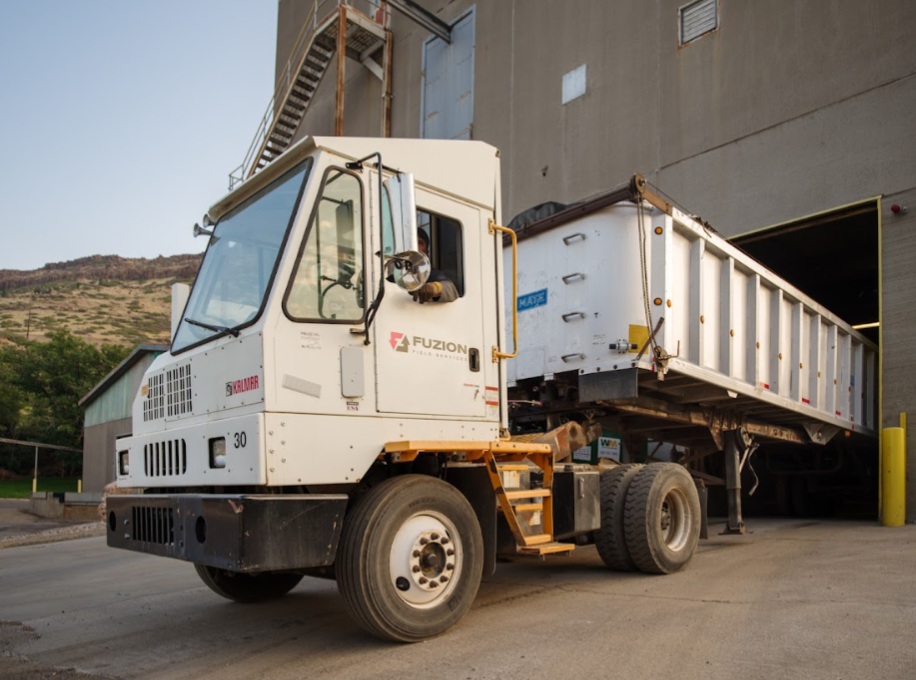
Fuzion Field Services manages the full operational side of composting programs with a focus on efficiency, documentation, and compliance:
- Collection and transport — Coordinating reliable hauling from generator sites to regional composting facilities.
- Container placement — Positioning containers to prevent cross-contamination and streamline loading.
- Route scheduling — Maintaining consistent pickup intervals for predictable service and minimal downtime.
- Contamination checks — Inspecting loads to keep organic streams clean and acceptable for processing.
- Regulatory documentation — Recording every haul to satisfy state and federal reporting requirements.
Through its network of partner facilities, Fuzion expands access to regional processing capacity and maintains auditable diversion records for clients pursuing sustainability metrics. These programs operate as part of Fuzion’s sustainable resource management framework, connecting generators directly to end-use markets for finished compost.
Case in Practice: Food and Beverage Manufacturing Client
A food and beverage manufacturing client managed by Fuzion processes roughly 3,000 tons of organic waste each month, diverting 90 percent for industrial composting. That diversion prevents about 2 million pounds of CO₂-equivalent emissions monthly, about 24 million pounds per year, verified through documented hauling and facility records. Only 10 percent heads to landfill, proof that precise segregation and reliable transport turn plans into real, measurable benefits.
Challenges and Future Trends
Even mature composting programs must balance operational, regulatory, and technological variables to maintain efficiency and compliance.
Operational Challenges
Contamination from plastics and other non-compostables remains the largest obstacle to consistent performance. Regional gaps in processing capacity can extend haul distances and increase emissions, while local tipping fees and back-haul logistics affect overall hauling economics.
Partnering with composting facilities close to generation sites helps minimize both cost and carbon impact while improving turnaround time for container service.
Regulatory and Material Trends
Odor management and moisture control require ongoing monitoring, particularly in food-heavy streams. Many facilities now use biofilters and enclosed aeration systems to maintain compliance with local air-quality regulations.
Certification and labeling standards continue to evolve, clarifying how compostable packaging must behave within full-scale commercial systems.
Technology and Infrastructure Growth
Emerging tools, including aerated static-pile control systems, in-vessel reactors, and digital carbon-tracking platforms, are improving efficiency and verification accuracy across the sector. Automation and smart sensors reduce energy demand, enhance transparency, and allow clients to quantify diversion results across multiple waste streams.
As composting infrastructure expands nationwide, collaboration between haulers and processors will determine how quickly capacity scales. Fuzion continues to integrate these innovations to maintain traceable, high-diversion operations consistent with its landfill-diversion commitments.
Work with Fuzion to Implement Reliable Composting Programs
Fuzion designs and manages composting operations aligned with EPA-approved treatment methods for organic waste. Each program tracks measurable CO₂-equivalent reductions and supports nutrient recovery that keeps resources in productive use. Contact us today and collaborate with a field team that delivers accountable, compliant results across every stage of service.