
Where a facility sends its organic waste affects emissions, landfill diversion, and whether those nutrients return to productive use. When collected and processed appropriately, that material can be managed through controlled aerobic decomposition. Industrial composting turns organic waste into a stable soil amendment while supporting documented landfill diversion and lower modeled emissions for some waste streams.
What Industrial Composting Means
Modern systems scale natural decomposition into a controlled industrial process.
Large-Scale Biological Conversion
This process refers to the large-scale biological conversion of organic material into a uniform, stable finished product. Commercial facilities manage temperature and airflow while monitoring moisture and oxygen throughout the process.
These environmental controls support microbial activity, accelerate decomposition, and help produce finished compost suitable for appropriate agricultural or landscape uses.
Advanced Facility Capabilities
Modern composting operations are engineered for throughput, safety, and quality control at commercial volumes.
These engineered systems:
- Maintain appropriate time-temperature conditions for pathogen reduction when required
- Balance aeration and moisture to support microbial activity
- Track operational data to support compliance and process control
These controls help facilities handle continuous input streams efficiently and maintain consistent processing conditions, a critical advantage for food manufacturers, distribution centers, and municipalities managing steady volumes of organic material.
Feedstocks and Inputs
Depending on facility capabilities and acceptance requirements, operations can process a wide variety of organic materials at scale, including:
- Food scraps and paper fiber
- Landscaping debris and yard waste
- Food residuals and compostable packaging
- Biosolids and manufacturing by-products
Feedstocks are blended to achieve an appropriate carbon-to-nitrogen balance for microbial activity. Proper mixing and aeration support biological stabilization while reducing odor and pathogen risks.
Regulated Process and Performance Standards
Federal pathogen-control requirements apply when biosolids are part of the compost feedstock. Under 40 CFR Part 503, one compliance route for enclosed or forced-air static systems requires the material to remain at or above 131°F for three consecutive days. Turned windrows use a longer treatment window, with the material held at or above 131°F for at least 15 days and turned no fewer than five times during that period.
Those federal thresholds are specific to biosolids management rather than commercial composting as a whole. Other operating, testing, and end-use requirements depend on the feedstocks involved and the state or local rules governing the facility.
How Commercial-Scale Composting Works
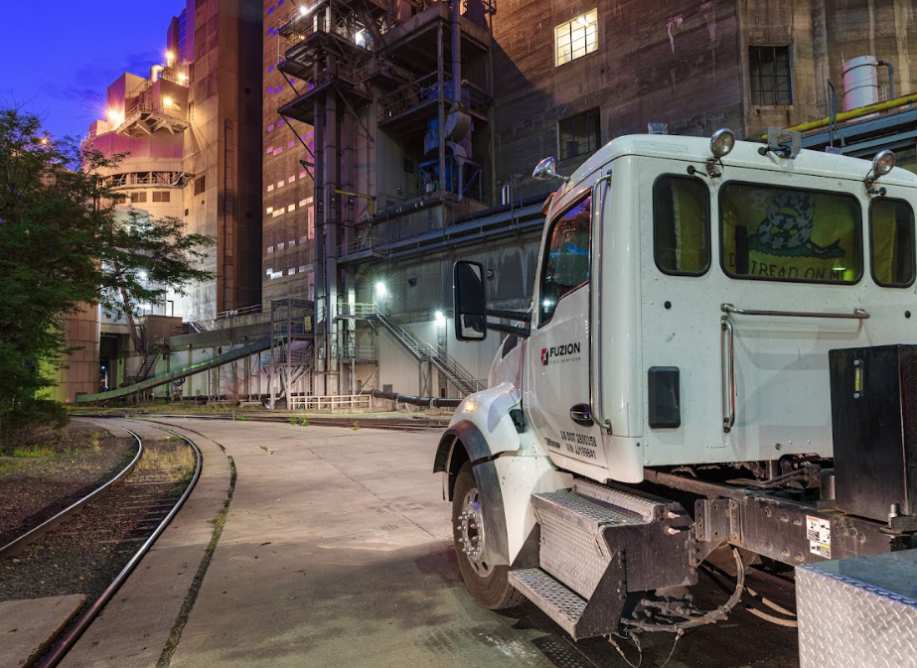
Large-scale industrial composting depends on organization in the field; collection, transport, and processing must run in sequence for the system to perform reliably.
Collection and Transport
On the ground, it starts with organized pickup routes and steady transport. Fuzion coordinates segregated collections that reduce contamination risk and move materials to regional composting facilities.
At receiving facilities, loads may be weighed and screened, while feedstocks are blended to achieve an appropriate carbon-to-nitrogen ratio. A ratio around 30:1 is a common starting target for active composting, although the appropriate mix varies with feedstock characteristics.
Active and Curing Phases
During the active phase, forced-air aeration or mechanical turning supplies oxygen while moisture is managed to sustain aerobic decomposition. Temperatures rise into the thermophilic range needed for rapid decomposition and pathogen control where applicable.
The curing phase allows material to stabilize before final screening removes oversized material that may be reused as bulking material.
Field Verification and Data Transparency
Fuzion’s hauling documentation tracks material from generator sites to intake points and finished output, giving sustainability managers a traceable chain of diversion data.
Operational reliability and reporting accuracy are supported through:
- Route scheduling: Coordinating pickups for haul efficiency
- Container placement: Limiting opportunities for cross-contamination
- Load monitoring: Checking material quality and contamination
These controls support consistent diversion performance and transparent reporting across multiple facilities.
Key Processing Methods at Industrial Scale
Large composting operations typically use one of three primary methods:
- Windrow composting: Organic material is arranged in long rows and turned periodically to maintain aeration, making the method suitable for sites with adequate space.
- Aerated static-pile composting: Air is supplied through pipes beneath or within a stationary pile, allowing high-volume processing with less mechanical turning.
- In-vessel composting: Materials are processed inside enclosed drums, containers, or tunnels where temperature, oxygen, and moisture can be closely controlled.
All three methods can produce stable finished compost when properly managed. Processing time, testing requirements, and permitted end uses vary with feedstock, operating conditions, facility requirements, and jurisdiction.
Environmental and Regulatory Benefits
At commercial scale, composting can reduce landfill-related emissions, recover nutrients for soil use, and support documented diversion and compliance goals.
Emission Reduction and Climate Impact
Composting food waste can produce a substantial greenhouse-gas advantage over landfilling. EPA’s Waste Reduction Model, or WARM, Version 16 estimates net emissions for food waste at about -0.15 metric tons of CO₂-equivalent per short ton when composted, compared with 0.50 metric tons when landfilled, a modeled difference of about 0.65 metric tons of CO₂-equivalent per short ton.
WARM is a high-level comparison model rather than a site-specific life-cycle assessment. Actual results vary with feedstock, transportation distance, composting conditions, landfill-gas management, and other operating assumptions.
Finished Compost Quality and Compostable-Product Standards
Compost nutrient content varies with feedstock and processing conditions. Oregon State University Extension reports common dry-weight ranges of about 1–2% nitrogen, 0.3–0.9% phosphorus, and 0.5–1.5% potassium, based on compost-analysis data.
For compostable products and packaging, BPI certification uses ASTM D6400 as a base standard for applicable products intended for commercial composting conditions. Certification does not mean every composting facility accepts the product.
Receiving facilities determine which certified or labeled materials they will accept based on their process, permits, contamination controls, and market requirements.
Compliance and Corporate Sustainability Alignment
Commercial composting requirements vary according to feedstock and jurisdiction. Facilities may be subject to state or local permitting and operating requirements involving odor, runoff, vectors, material acceptance, and other environmental controls, while biosolids composting must also satisfy applicable federal Part 503 requirements.
Documented diversion can support sustainability reporting. LEED v5 for Operations and Maintenance also recognizes composting as a waste-diversion strategy within its waste-reduction framework.
Industrial Composting vs. Landfilling: Why the Outcome Differs
When organic waste goes to a landfill instead of a managed aerobic system, the difference shows up in methane formation, leachate management, and whether carbon and nutrients return to productive use.
Methane and Leachate Follow Different Pathways
As oxygen is depleted in a landfill, organic material shifts toward anaerobic decomposition and methane formation. Landfill gas systems capture part of those emissions, but not all methane is recovered. Composting maintains aerobic conditions during active processing, which limits the conditions that generate methane. Composting is not methane-free, however; poorly aerated or overly wet material can develop anaerobic zones that produce methane. The size of the emissions advantage varies with feedstock, composting method, landfill-gas capture, transportation distance, and modeling assumptions.
Landfills must also manage leachate, the liquid that moves through buried waste and can carry dissolved organic material and other contaminants. Diverting organics keeps degradable material out of a disposal system that must collect and manage leachate, although leachate quantity and composition vary with precipitation, site design, waste characteristics, and operating conditions.
Composting Keeps Organic Material in Productive Use
Landfilling removes the carbon and nutrients in organic material from productive use. Those resources remain buried rather than being recovered for soil applications. Composting converts the material into a stabilized soil amendment, allowing nutrients and carbon to return to landscapes or agricultural soils instead of remaining locked inside a disposal system.
Finished compost can improve soil condition, support water retention, and contribute nutrients for plant growth, giving diverted organics a productive end use rather than leaving them buried as waste.
Fuzion’s Role in Industrial Composting
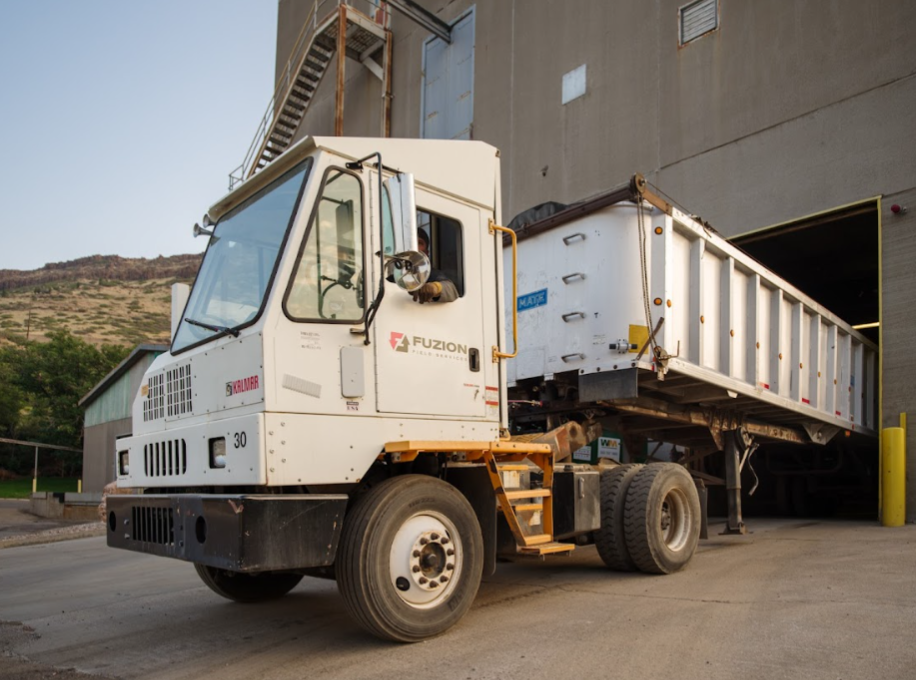
Fuzion Field Services manages the operational side of composting programs with a focus on efficiency, documentation, and compliance:
- Collection and transport: Coordinating reliable hauling from generator sites to regional composting facilities
- Container placement: Positioning containers to reduce cross-contamination and streamline loading
- Route scheduling: Maintaining consistent pickup intervals for predictable service and minimal downtime
- Contamination checks: Inspecting loads to keep organic streams clean and acceptable for processing
- Regulatory documentation: Recording haul data to support applicable regulatory and client reporting requirements
Through its network of partner facilities, Fuzion expands access to regional processing capacity and maintains auditable diversion records for clients pursuing sustainability metrics. These programs operate as part of Fuzion’s sustainable resource management framework, connecting generators directly to end-use markets for finished compost.
Case in Practice: Food and Beverage Manufacturing Client
A food and beverage manufacturing client managed by Fuzion processes roughly 3,000 tons of organic waste each month, diverting 90 percent for industrial composting. That diversion prevents about 2 million pounds of CO₂-equivalent emissions monthly, about 24 million pounds per year, verified through documented hauling and facility records. Only 10 percent heads to landfill, showing how segregation and reliable transport can produce measurable diversion results.
Challenges and Future Trends
Commercial composting programs still face contamination, processing-capacity, hauling, odor, and regulatory challenges.
Operational Challenges
Contamination from plastics and other non-compostables remains a major obstacle to consistent performance. Programs manage contamination through source separation, clear container rules, load checks, and coordination with each receiving facility’s acceptance requirements. Regional gaps in processing capacity can extend haul distances and increase emissions, while local tipping fees and back-haul logistics affect overall hauling economics.
Using composting facilities closer to generation sites can reduce haul distance and related transportation costs and emissions while improving turnaround time for container service.
Facilities often manage organics alongside other waste streams, so composting decisions need to fit within a broader industrial waste management program that may also include industrial recycling.
Regulatory and Material Trends
Odor and moisture require ongoing management, particularly with food-heavy feedstocks. Facilities may use biofilters, covers, enclosed systems, controlled aeration, and other techniques to manage odors and maintain acceptable operating conditions.
Certification and labeling standards continue to evolve as compostable-product requirements become more specific and facilities refine what they will accept.
Technology and Infrastructure Growth
Automated aeration controls and temperature sensors can give composting operators tighter control over processing conditions. Digital tracking tools can improve recordkeeping and help organizations quantify diversion across multiple waste streams.
Work with Fuzion to Implement Reliable Composting Programs
Fuzion coordinates organic-waste collection, transportation, contamination controls, and diversion documentation with regional processing partners. Its records can support measurable diversion and emissions reporting while helping clients keep organic material in productive use. Contact us today for more information.
Frequently Asked Questions
The questions below cover the process, landfill impacts, contamination, and how Fuzion documents diversion.
What Is Industrial Composting and How Does It Work at Commercial Scale?
Commercial-scale composting uses controlled temperature, oxygen, moisture, and material balance to process large volumes of organic waste through aerobic decomposition. At commercial scale, the process coordinates collection, active decomposition, curing, screening, and documentation to produce stable finished compost.
Is Composting Better for the Environment Than Landfilling?
EPA’s WARM Version 16 models food waste at about −0.15 metric tons of CO2-equivalent per short ton for composting, compared with 0.50 metric tons for landfilling, a difference of about 0.65 metric tons per short ton. Actual results vary by transportation, processing conditions, landfill-gas management, and other site-specific factors.
What Happens to Organic Waste in a Landfill?
Organic waste in a landfill decomposes under increasingly oxygen-limited conditions, which can generate methane. Landfills also collect and manage leachate as liquid moves through buried waste, while composting manages aerobic decomposition and converts suitable organic material into a soil amendment.
What Contamination Issues Affect Composting Programs?
Plastics and other non-compostable materials can contaminate organic waste streams, reduce processing efficiency, or cause loads to be rejected. Source separation, proper container placement, load inspections, contamination monitoring, and coordination with receiving facilities help keep commercial programs within acceptance requirements.
How Does Fuzion Handle Organic Waste Collection, Documentation, and Diversion Reporting?
Fuzion coordinates segregated collection, container placement, transportation, contamination checks, and hauling documentation from generator sites to processing facilities. That chain-of-custody data supports auditable diversion reporting and allows clients to track measurable results across locations.