
A dumpster scheduled for a Denver street needs City authorization in place before delivery. Keeping the entire container on private property generally avoids Denver’s right-of-way permitting process. When public ROW placement requires a Denver dumpster permit, the dumpster company handles the City process, including the applicable permit path, processing requirements, and fee.
When a Denver Dumpster Permit Is Required
A Denver dumpster may need City approval depending on where the container will sit. A location that extends beyond private property into public ROW requires the applicable authorization before delivery. Because the ROW boundary can extend past the paved street, part of a driveway or frontage that appears private may still fall within it.
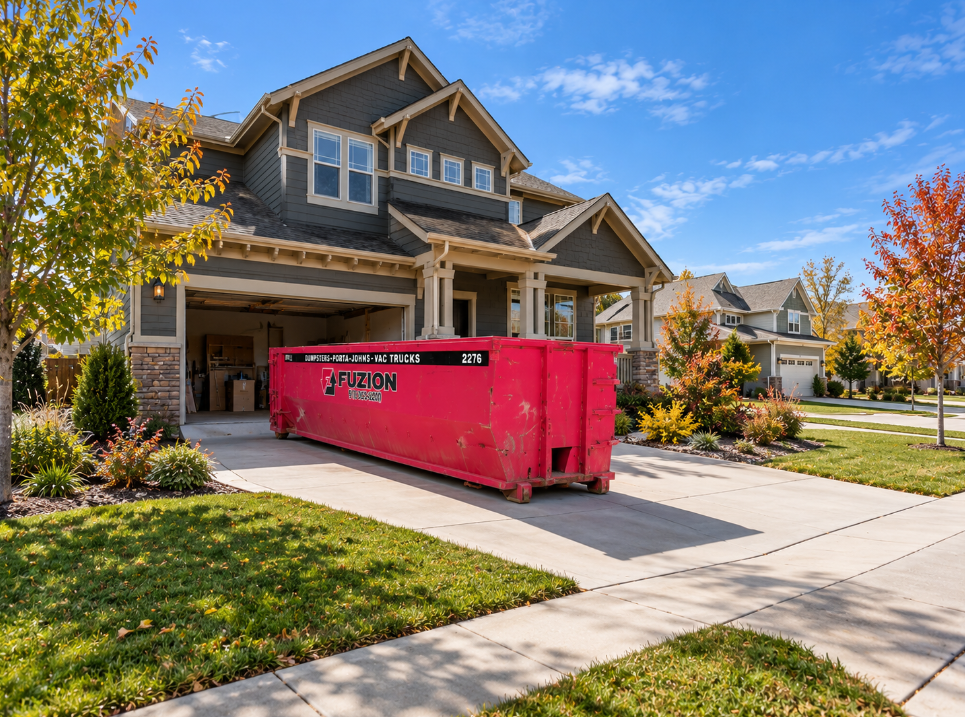
Driveway placement can avoid Denver’s ROW permitting process when the entire container stays inside the property’s private boundaries. Available space still has to accommodate the container, so choosing the right dumpster size can determine whether that option will work. Separately, HOA dumpster restrictions may control temporary container use even when the proposed location does not involve City ROW.
| Placement Location | Permit Required? | Who Obtains It | Notes |
|---|---|---|---|
| Entirely on private property outside public ROW | Generally no Denver ROW permit | N/A | Property boundaries, delivery access, and HOA rules may still matter |
| Parking lane on a residential street | Yes | Dumpster company | The hauler may use its Residential Annual Permit or obtain a Residential One-Time Permit |
| Arterial or collector street | Yes | Dumpster company | The residential annual authorization does not apply; the hauler needs a separate one-time Street Occupancy Permit |
| Metered parking location | Yes | Dumpster company | A separate Street Occupancy/Meter permit is required |
| Alley or sidewalk | Not eligible for dumpster placement under current Denver rules | N/A | The City does not allow dumpsters to take up or block these locations |
City approval does not make every ROW location available for a dumpster. Denver’s current dumpster and container permit requirements exclude alleys and sidewalks from acceptable container placement.
Who Handles the Permit?
The homeowner or GC provides the project information, but the permitting responsibility stays with the dumpster company. Denver puts that responsibility on the business that controls where the container is positioned and how it is handled. For curbside delivery, the customer supplies the address, preferred location, and schedule so the hauler can determine which City authorization fits the site. When arranging dumpster rentals in Denver, providing those details early also gives the company time to coordinate permitting with the requested delivery date.
Holding a Denver ROW Dumpster License allows a company to enter the City’s dumpster-permitting process, but it does not approve a container for a particular address. Denver’s one-time dumpster and container requirements call for the company’s license number when it seeks the Revocable Street Occupancy Permit associated with a specific ROW placement.
Denver’s Annual and One-Time Dumpster Permit Options
Denver gives licensed dumpster companies both recurring and site-specific ways to authorize qualifying street placements.
Residential Annual Permit
For eligible residential streets, a qualifying hauler can operate through Denver’s Residential Annual Permit program. Denver’s current annual requirements make this a company-level authorization rather than a permit issued to a homeowner for one property.
Arterial, Collector, and Residential One-Time Permits
The annual residential route does not cover every address. A dumpster going onto an arterial or collector street, or into metered parking, moves into the appropriate separate Street Occupancy or Meter process.
Denver also has a one-time option for residential street locations that are not handled through the annual authorization. Because this approval is tied to an individual placement, the hauler needs the address, proposed dates, and container information before submitting the application. The hauler determines the correct Denver dumpster permit from the address and proposed placement.
How Long Does Denver Permit Processing Take?
For a one-time dumpster placement, build at least five business days into the schedule for City review. Street classification and sightline conditions can require additional review. Missing or unclear application materials, including the traffic-control plan, can also lengthen processing.
Denver uses the same five-business-day planning window for separate Street Occupancy or Meter applications. Customers planning a street delivery should therefore give the hauler the placement information before the desired delivery date rather than waiting until the container is already scheduled. Permit timing also has to match delivery and pickup, so establishing how long you need the dumpster gives the hauler the dates needed for the rental and any location-specific ROW authorization.
What Does a Denver Dumpster Permit Cost?
Permit cost changes according to the authorization used and, for one-time placements, how long the container remains in the ROW. Denver’s currently posted consolidated fee schedule provides the applicable annual and one-time rates. For a company buying the minimum five residential annual permits, the initial City charge totals at least $1,000. Renewing that five-permit set costs at least $625, based on Denver’s posted rates of $200 per permit for first issuance and $125 per permit for renewal.
A one-time residential placement starts at $125, with an additional $4.50 charged for each day beyond the first five. Collector or arterial placement uses the same $125 starting charge, but the added daily rate after day five increases to $7.50. The licensed hauler should confirm the current charge for the proposed location before delivery.
ROW Placement Without Proper Authorization
A dumpster placed in the public ROW can result in a City charge if the hauler cannot show that the required permit application was submitted. Denver currently posts that dumpster noncompliance charge at $500. Compliance also continues after delivery, and Denver can revoke an annual permit when its requirements are not followed.
Those permit rules govern where the container can sit. Separate waste management dumpster rules govern the materials that can go into it.
Ask Your Hauler About Its ROW Dumpster License
Before scheduling curbside placement, ask the dumpster company one direct question: Do you currently hold a Denver ROW Dumpster License?
Fuzion holds an active ROW Dumpster License with the City of Denver and handles permit coordination as part of delivery. If the proposed location requires a Denver dumpster permit, the customer supplies the address and project information while Fuzion manages the applicable City process. The customer still selects the container size and rental dates and identifies the preferred placement.
Schedule Your Denver Dumpster Rental With Fuzion
Fuzion can help determine the placement requirements, coordinate the applicable City permit process, and provide the right container for your project. Fuzion’s dumpster rental service keeps the delivery and permitting details coordinated before the container arrives. Contact us today for more information.
Frequently Asked Questions
A few practical questions usually remain once the delivery location is chosen.
Can I Put a Dumpster in My Denver Driveway Without a Permit?
Generally, yes, provided the entire container stays within the property’s private boundaries and does not extend into Denver-controlled ROW. Confirm where that boundary actually falls and check any HOA restrictions before choosing the driveway location.
Do I Have to Apply for a Denver Dumpster Permit Myself?
No. The customer supplies the project and placement information, but the dumpster company handles the City permit process.
How Far Ahead Should I Plan for Street Placement?
Give the permitting process a full workweek before the planned street delivery. Denver’s guidance uses five business days as the standard review window, and site or application issues can extend that timeline.
What’s the Difference Between the Annual and One-Time Permit?
Which permit applies depends on the location and the hauler’s existing authorization. A qualifying company can cover eligible residential-street placements through its annual permit, while a single residential address may use the one-time option; arterial, collector, and metered locations follow separate Street Occupancy or Meter permitting.
Can a Dumpster Go in a Denver Alley or on the Sidewalk?
No. Denver’s current dumpster rules exclude alleys and sidewalks as acceptable places for a container. Receiving approval for another ROW location does not make either of those locations available for dumpster placement.